Security & RBAC
RBAC & permissions
Authorization on the DataFlow AI Platform is governed by a hierarchical role-based access-control (RBAC) model. The catch: there are three different role vocabularies — Keycloak realm roles, the backend DataFlowRole hierarchy, and the frontend personas — that must be reconciled by hard-coded mapping tables. This page documents all three, the full permission matrices, how enforcement works, and the known gaps.
Three role vocabularies
A single human user is described by three different role names depending on which layer you are looking at. Understanding the mapping between them is essential to reasoning about access.
| Layer | Vocabulary | Source |
|---|---|---|
| Identity provider | Keycloak realm roles | realm-export.json |
| Backend services | DataFlowRole hierarchy | RBACService.kt (common module) |
| Frontend SPA | Personas (PersonaId) | frontend/src/types/permissions.ts |
1. Keycloak realm roles
The dataflow realm ships six realm roles: org_admin, workspace_admin, developer, analyst, operator, and viewer. org_admin is a composite role that includes the other five.
2. Backend DataFlowRole hierarchy
RBACService.DataFlowRole defines five ordered roles, each with a numeric level:
ADMIN(100) > ENGINEER(75) > ANALYST(50) > STEWARD(40) > VIEWER(25)
A role grants any permission whose requiredRole.level is less than or equal to the user's role level (RBACService.hasPermission).
3. Frontend personas
The SPA models four personas (PersonaId): admin, engineer, analyst, and steward. Each persona maps to a fixed set of permissions and a list of allowed route prefixes.
The vocabularies do not line up
Keycloak ships developer, operator, and org_admin — there is no STEWARD realm role and no ENGINEER realm role. The backend and frontend, by contrast, expect engineer and steward. A "steward" in Keycloak can only arrive via an AD group (PLK-BI-Stewards) or a data_steward role name, neither of which is in the shipped realm export. The seeded example user "Tomasz Zielinski / Data Steward" actually carries the realm role viewer.
Mapping tables
Keycloak groups → realm roles
The realm export maps four corporate-style groups onto realm roles:
| Group | Realm role granted |
|---|---|
/PLK-BI-Admins | org_admin |
/PLK-BI-Engineers | developer |
/PLK-BI-Analysts | analyst |
/PLK-BI-Operations | operator |
KeycloakJwtConverter and RBACService additionally know about PLK-BI-Stewards and PLK-BI-Viewers, but those groups are not present in the shipped realm export.
Seeded users
| Username | Realm role | Group | Title attribute |
|---|---|---|---|
| anna.kowalska@polkomtel.pl | developer | PLK-BI-Engineers | Data Engineer |
| marek.nowak@polkomtel.pl | analyst | PLK-BI-Analysts | Business Analyst |
| katarzyna.wisniewski@polkomtel.pl | org_admin | PLK-BI-Admins | Platform Admin |
| tomasz.zielinski@polkomtel.pl | viewer | (none) | Data Steward |
All four seeded users have empty credentials and requiredActions: [UPDATE_PASSWORD].
Any raw role → DataFlowRole
The gateway maps every raw role string it sees — realm roles, client roles, group names, and group paths — onto a single DataFlowRole (RBACService.mapSingleRole / KeycloakJwtConverter). The highest mapped role wins; the default is VIEWER.
| Raw role / group | Resolved DataFlowRole |
|---|---|
PLK-BI-Admins, /PLK-BI-Admins | ADMIN |
admin, dataflow-admin, org_admin, workspace_admin, platform_admin | ADMIN |
PLK-BI-Engineers | ENGINEER |
engineer, dataflow-engineer, data_engineer, developer, operator | ENGINEER |
PLK-BI-Analysts | ANALYST |
analyst, dataflow-analyst, business_analyst | ANALYST |
PLK-BI-Stewards | STEWARD |
steward, dataflow-steward, data_steward | STEWARD |
PLK-BI-Viewers | VIEWER |
viewer, dataflow-viewer | VIEWER |
ROLE_*-prefixed names | Same mapping after the prefix is stripped |
| Unrecognised role | Skipped — no implicit grant (FR-020) |
KeycloakJwtConverter.extractAuthorities converts the resolved role into Spring ROLE_* authorities. If a JWT has no mappable roles, the authority set is empty and the request is rejected by @PreAuthorize — a deliberate anti-privilege-escalation choice. The org_admin / developer / operator mappings were added late to fix users who were otherwise silently downgraded to ANALYST or VIEWER.
Why the mapping defaults matter
The "highest wins, default VIEWER, unrecognised skipped" rules mean an unknown role string never escalates privilege — but a misspelled expected role silently downgrades a user. The mapping tables are the single fragile point reconciling all three vocabularies.
Backend permission matrix
RBACService defines a catalogue of 30 permissions, each tagged with a requiredRole. Because the model is hierarchical, a role receives a permission when its level is ≥ the permission's required-role level.
Permissions by domain
| Domain | Permission → required role |
|---|---|
| Pipeline | VIEW_PIPELINE→VIEWER; CREATE/EDIT/RUN/SCHEDULE_PIPELINE→ENGINEER; DELETE_PIPELINE→ADMIN |
| Connection | VIEW_CONNECTION→VIEWER; CREATE/EDIT/TEST_CONNECTION→ENGINEER; DELETE_CONNECTION→ADMIN |
| Monitoring | VIEW_MONITOR→VIEWER; ACKNOWLEDGE_ALERT→ANALYST; CONFIGURE_ALERT→ENGINEER; DELETE_ALERT→ADMIN |
| Lineage | VIEW_LINEAGE→VIEWER; EDIT_LINEAGE→ENGINEER |
| Migration | VIEW_MIGRATION→VIEWER; CREATE_MIGRATION→ENGINEER; EXECUTE_MIGRATION→ADMIN |
| AI Copilot | USE_COPILOT→ANALYST; CONFIGURE_COPILOT→ADMIN |
| Workspace | VIEW_WORKSPACE→VIEWER; EDIT_WORKSPACE/MANAGE_MEMBERS→ADMIN |
| User management | VIEW_USERS→ANALYST; MANAGE_USERS→ADMIN |
| Audit | VIEW_AUDIT_LOG→ANALYST; EXPORT_AUDIT_LOG→ADMIN |
| System | VIEW_SYSTEM_SETTINGS/MODIFY_SYSTEM_SETTINGS→ADMIN |
Roles × permissions (hierarchical)
✔ = granted. Levels: ADMIN 100, ENGINEER 75, ANALYST 50, STEWARD 40, VIEWER 25.
| Permission tier (required role) | ADMIN | ENGINEER | ANALYST | STEWARD | VIEWER |
|---|---|---|---|---|---|
VIEW_PIPELINE / VIEW_CONNECTION / VIEW_MONITOR / VIEW_LINEAGE / VIEW_MIGRATION / VIEW_WORKSPACE (VIEWER) | ✔ | ✔ | ✔ | ✔ | ✔ |
ACKNOWLEDGE_ALERT / USE_COPILOT / VIEW_USERS / VIEW_AUDIT_LOG (ANALYST) | ✔ | ✔ | ✔ | – | – |
CREATE/EDIT/RUN/SCHEDULE_PIPELINE / CREATE/EDIT/TEST_CONNECTION / CONFIGURE_ALERT / EDIT_LINEAGE / CREATE_MIGRATION (ENGINEER) | ✔ | ✔ | – | – | – |
DELETE_PIPELINE / DELETE_CONNECTION / DELETE_ALERT / EXECUTE_MIGRATION / CONFIGURE_COPILOT / EDIT_WORKSPACE / MANAGE_MEMBERS / MANAGE_USERS / EXPORT_AUDIT_LOG / VIEW_SYSTEM_SETTINGS / MODIFY_SYSTEM_SETTINGS (ADMIN) | ✔ | – | – | – | – |
STEWARD hierarchy inversion
STEWARD sits at level 40, below ANALYST at level 50. A STEWARD therefore inherits only VIEWER-level hierarchical permissions from RBACService. Any real steward authority comes exclusively from controllers that name STEWARD explicitly in their @PreAuthorize lists — not from the role hierarchy. The frontend persona model (below) instead gives the steward broad governance rights, so the two models genuinely disagree about how powerful a steward is.
Workspace-aware checks
RBACService also exposes workspace-scoped checks layered on top of the permission checks:
canAccessWorkspace— ADMIN sees all workspaces; thedefaultworkspace is open to everyone; any other workspace requires membership.canModifyPipeline,canDeletePipeline,canRunPipeline— each evaluates the relevant permission and the workspace check.
Frontend permission matrix
The frontend permission catalogue (frontend/src/types/permissions.ts) defines 28 permissions as domain:action strings spanning pipeline, quality, governance, lineage, code, admin, system, and catalog domains. (The file's header comment says "26"; the actual list is 28.) Permissions are assigned per persona via personaPermissions, and the model is described as backed server-side by the metadata-service PolicyEngine.kt.
Persona × permissions
✔ = granted. The admin persona holds all 28 permissions.
| Permission | engineer | analyst | admin | steward |
|---|---|---|---|---|
pipeline:view | ✔ | ✔ | ✔ | ✔ |
pipeline:create | ✔ | – | ✔ | – |
pipeline:edit | ✔ | – | ✔ | – |
pipeline:run | ✔ | ✔ | ✔ | – |
pipeline:delete | ✔ | – | ✔ | – |
pipeline:deploy | ✔ | – | ✔ | – |
pipeline:debug | ✔ | – | ✔ | – |
quality:view | ✔ | ✔ | ✔ | ✔ |
quality:create | ✔ | – | ✔ | ✔ |
quality:edit | ✔ | – | ✔ | ✔ |
quality:evaluate | – | ✔ | ✔ | ✔ |
governance:policy | – | – | ✔ | ✔ |
governance:review | – | – | ✔ | ✔ |
governance:approve | – | – | ✔ | ✔ |
lineage:view | ✔ | ✔ | ✔ | ✔ |
lineage:edit | – | – | ✔ | ✔ |
code:view | ✔ | ✔ | ✔ | – |
code:review | ✔ | – | ✔ | – |
code:commit | ✔ | – | ✔ | – |
admin:users | – | – | ✔ | – |
admin:workspace | – | – | ✔ | – |
admin:security | – | – | ✔ | – |
admin:infrastructure | – | – | ✔ | – |
admin:billing | – | – | ✔ | – |
system:settings | – | – | ✔ | – |
catalog:view | ✔ | ✔ | ✔ | ✔ |
catalog:edit | – | – | ✔ | ✔ |
catalog:classify | – | – | ✔ | ✔ |
Note how the frontend steward persona holds rich governance:*, quality:*, lineage:edit, and catalog:* permissions — exactly the authority the backend hierarchy denies a STEWARD (level 40). This divergence is one of the known gaps.
How enforcement works
Authorization is enforced in two layers: the gateway checks token validity and role presence; each service applies fine-grained method-level and workspace/ownership checks.
 Request ──▶ API Gateway ──▶ Downstream service ──▶ @PreAuthorize ──▶ workspace check
              │                  │                       │
              │ token valid?     │ JWT re-validated      │ method-level
              │ role present?    │ X-User-* → context    │ role/permission
              ▼                  ▼                       ▼
        coarse HTTP rule    SecurityContext        fine-grained grant
Gateway-level rules
When dev-permit-reads=false, the gateway's reactive SecurityConfig applies coarse method-based rules to /api/v1/**:
| HTTP method | Required authority |
|---|---|
DELETE | ROLE_ADMIN |
POST / PUT / PATCH | ROLE_ADMIN or ROLE_ENGINEER |
GET | ROLE_ADMIN, ROLE_ENGINEER, ROLE_ANALYST, ROLE_STEWARD, or ROLE_VIEWER |
| Any other exchange | Authenticated |
When dev-permit-reads=true, all GETs plus the copilot / ai / catalog-ask / search POSTs become permitAll.
Service-level @PreAuthorize
Downstream services run @EnableMethodSecurity(prePostEnabled = true), so controllers carry @PreAuthorize annotations. Because KeycloakJwtConverter produces real ROLE_* authorities, hasRole / hasAnyRole evaluate genuine Keycloak roles. A representative sample of observed guards:
| Service / controller | Endpoint group | Guard |
|---|---|---|
lineage-service BiLineageController | BI lineage | hasAnyAuthority('ROLE_ADMIN','ROLE_STEWARD') |
lineage-service PropagationController | propagation | hasRole('ADMIN') |
lineage-service LineageAuthoringController | authoring | hasAnyRole('STEWARD','ADMIN') |
monitor-service AdminScheduledReportsController | scheduled reports | hasAnyRole('ADMIN','STEWARD') |
metadata-service WorkspaceController | workspace CRUD | hasRole('ADMIN') (all methods) |
metadata-service UserController | user management | hasRole('ADMIN') (all methods) |
metadata-service AuditLogController | audit log | hasRole('ADMIN') |
metadata-service ConnectionController | connections | read = 5-role; create/edit/test = ADMIN/ENGINEER; delete = ADMIN |
metadata-service CdrMetricsController | CDR metrics | read = 5-role; write = ADMIN/ENGINEER |
metadata-service PiiClassifierController | PII classify | scan = ADMIN/ANALYST/STEWARD/ENGINEER; mutate = ADMIN/STEWARD |
metadata-service TagController | tag policy | hasAnyRole('governance-admin','data-steward','admin') or hasAuthority('SCOPE_governance:policy') |
metadata-service SearchController | search / reindex | search = permitAll(); reindex = hasAnyRole('ADMIN','PLATFORM_OPS') |
pipeline-engine ErasureController | GDPR erasure | hasAnyRole('ADMIN','STEWARD') |
pipeline-engine QuarantineController | quarantine | read = ADMIN/DATA_STEWARD/DATA_ENGINEER; mutate = ADMIN/DATA_STEWARD; release = ADMIN |
Frontend route guards
Frontend RBAC is UX only — the SPA is a public client and real enforcement is always server-side. Still, the frontend prevents users from navigating to pages they cannot use:
ProtectedRouteshows a spinner whileisLoading, redirects to/loginif!isAuthenticated, then callscanAccess(effectivePersona, pathname)and rendersAccessDeniedon failure.effectivePersonais the persona store in dev mode, otherwiseuser.persona.
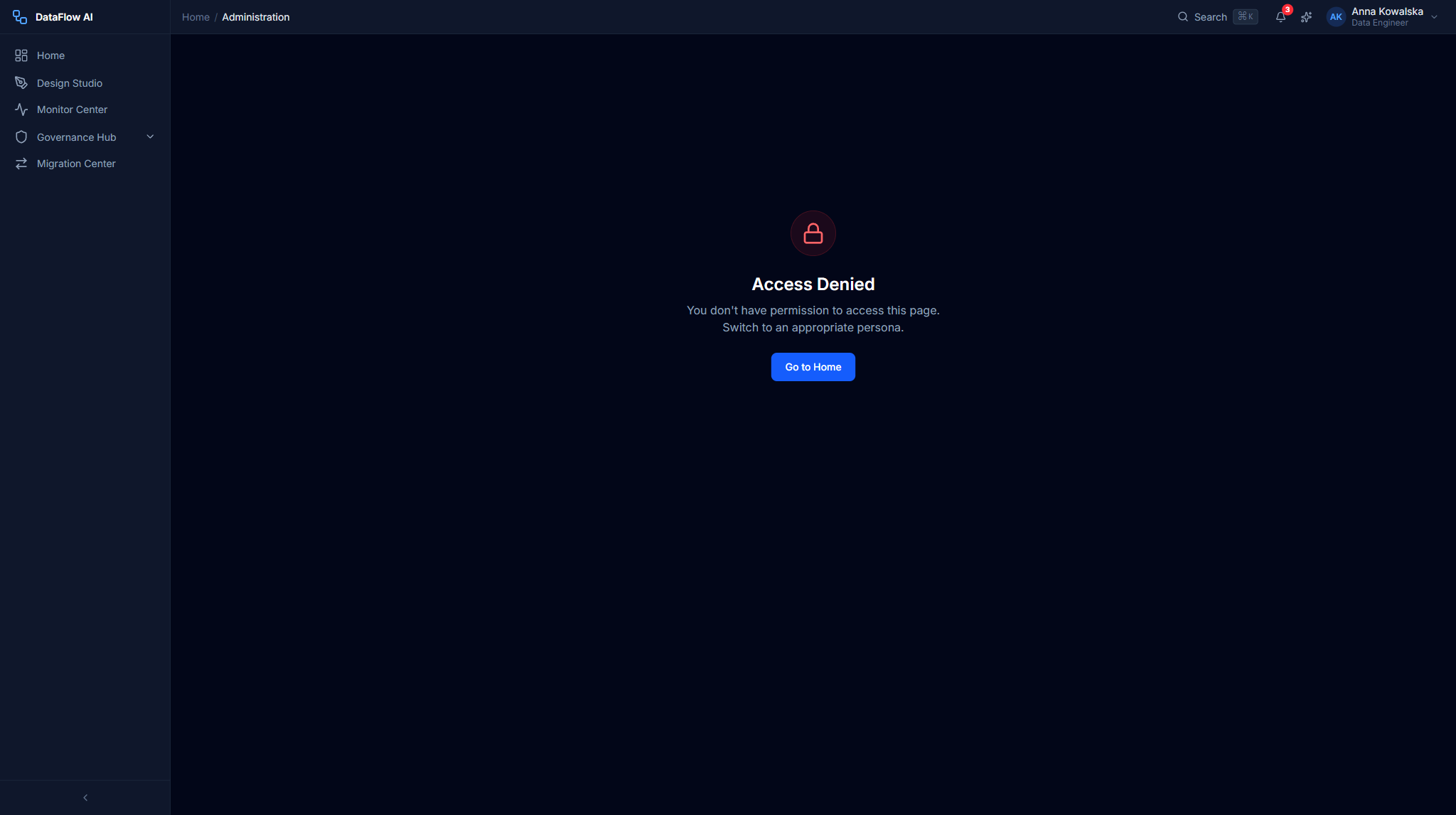
- Route-prefix RBAC —
data/permissions.tsdefinespersonaRoutes;canAccessmatches an allowed prefix exactly or asprefix + '/'. This map is locked bypermissions-rbac.test.ts(65 assertions). PermissionGateis a component-level gate built on theusePermission/usePermissions/useAnyPermissionhooks, supporting single or multiple permissions withrequireAlland an optionalfallback.useAuth().hasRole(role)checksrealmRoles;useAuth().hasPermission(perm)checks the persona-derivedpermissionsarray.
Allowed route prefixes per persona
| Persona | Allowed route prefixes |
|---|---|
| engineer | /, /design-studio, /monitor, /governance, /migration, /connections, /data-marketplace, /marketplace, /my-pipelines, /pipelines, /data-browser, /templates, /admin/incidents, /telecom |
| analyst | /, /my-pipelines, /data-browser, /data-marketplace, /marketplace, /monitor, /governance/quality, /governance/lineage |
| admin | /, /design-studio, /monitor, /governance, /migration, /admin, /connections, /my-pipelines, /pipelines, /data-browser, /templates, /data-marketplace, /marketplace, /telecom |
| steward | /, /monitor, /governance, /data-browser, /data-marketplace, /marketplace, /admin/audit-log, /admin/access-reviews, /admin/incidents |
Known risks & gaps
The research flagged several authorization-correctness issues worth tracking.
Mismatched @PreAuthorize roles
Several controllers guard endpoints with role names that a real Keycloak token can never carry. KeycloakJwtConverter only ever emits the five canonical authorities ROLE_ADMIN, ROLE_ENGINEER, ROLE_ANALYST, ROLE_STEWARD, and ROLE_VIEWER. Guards such as:
hasRole('DATA_STEWARD')andhasRole('DATA_ENGINEER')—QuarantineControllerhasRole('PLATFORM_OPS')—SearchControllerreindexhasAnyRole('governance-admin','data-steward')—TagController
...would never match a genuine user. Those endpoints are effectively inaccessible to real users — they only become reachable in dev-permit-reads mode, where the anonymous user is granted a broad role set that happens to include ROLE_DATA_STEWARD / ROLE_DATA_ENGINEER. This is a real authorization-correctness defect.
STEWARD hierarchy inversion
As noted above, STEWARD (level 40) ranks below ANALYST (level 50) in the backend hierarchy, so a STEWARD inherits only VIEWER-level permissions from RBACService — while the frontend persona model grants the steward broad governance, quality, lineage, and catalog rights. The two models disagree on how powerful a steward is, and STEWARD authority on the backend depends entirely on explicit @PreAuthorize lists rather than the hierarchy.
The dev-permit-reads escape hatch
dataflow.gateway.dev-permit-reads (default false) is a powerful switch. When true it permits all GETs unauthenticated and grants the downstream anonymous user a wide role set (ROLE_ADMIN, ROLE_DPO, ROLE_COMPLIANCE_OFFICER, ROLE_AUDITOR, ROLE_STEWARD, ROLE_OPS, ROLE_ENGINEER, ROLE_USER, ROLE_DATA_ENGINEER, ROLE_DATA_STEWARD). It must be false in production, and no environment guard was found that enforces this.
Other observations
- Role-vocabulary fragmentation — three role systems reconciled only by hard-coded mapping tables in
RBACService,KeycloakJwtConverter, andkeycloak.ts. Theorg_admin/developermappings were a late bug fix. - Doc drift — the admin guide describes a
MANAGERrole and adataflow-uiclient that exist in neither the code nor the realm export.
Net effect for operators
When auditing access, never assume the three role models agree. Verify against the actual RBACService hierarchy and the KeycloakJwtConverter mapping table — and confirm dev-permit-reads is false in any production deployment.
Summary
| Topic | Key fact |
|---|---|
| Vocabularies | Keycloak realm roles, backend DataFlowRole, frontend personas — reconciled by mapping tables |
| Backend hierarchy | ADMIN(100) > ENGINEER(75) > ANALYST(50) > STEWARD(40) > VIEWER(25) |
| Backend permissions | 30 permissions, granted when role level ≥ required-role level |
| Frontend permissions | 28 domain:action permissions assigned per persona |
| Enforcement | Gateway coarse HTTP rules + service @PreAuthorize + workspace checks |
| Frontend RBAC | UX-only route guards and PermissionGate — real enforcement is server-side |
| Top risks | Unmatched @PreAuthorize roles, STEWARD inversion, dev-permit-reads escape hatch |
For the authentication side of the picture — how an identity is established before any of these checks run — see Authentication & SSO.